At the Aim Higher Society of Canada, we believe that a better future is possible when people come together with compassion, purpose, and action.
We are a helping society made up of dedicated individuals committed to strengthening our communities and supporting people facing some of life’s most difficult challenges. Our mission is to help build a better future for society as a whole by addressing addiction, recovery, housing vulnerability, and homelessness through education, fundraising, employment training, addiction recovery support, harm reduction projects, and community-based action.
We recognize that addiction, homelessness, poverty, and lack of opportunity are deeply connected issues. Real change requires more than temporary solutions. It requires understanding, dignity, practical support, and pathways forward. That is why Aim Higher Society works to create opportunities for healing, learning, stability, and personal growth.
Through our programs and community initiatives, we aim to support individuals and families while also raising awareness, building partnerships, and creating meaningful ways for people to contribute. Whether through volunteering, fundraising, advocacy, training, or direct support, every effort helps move our communities toward a safer, healthier, and more hopeful future.
Aim Higher Society of Canada welcomes all who share our vision of compassion, recovery, opportunity, and community. Together, we can help people rise above hardship, rebuild lives, and aim higher for a better tomorrow.
Rebuilding Modern Society: Expanding the New Social Compact
Beyond Shelter: The Architecture of Dignity
The traditional approach to homelessness treats it as a housing problem requiring housing solutions. But this new compact recognizes a fundamental truth: homelessness is a rupture in the social fabric itself—a severance of the basic bonds that connect individuals to community, purpose, and self-worth. Housing without community becomes mere containment; employment without support becomes exploitation; food without fellowship becomes subsistence.
This compact proposes something radical yet ancient: the recognition that human flourishing requires belonging as much as it requires bread.
The Three Pillars Reimagined
Housing as Foundation, Not Finish Line
Housing in this model is unconditional—not a reward for sobriety, not contingent on employment, not dependent on navigating bureaucratic mazes. It’s the stable ground from which all other growth becomes possible. But it’s designed not as isolated units but as intentional community:
Mixed-income developments where formerly homeless individuals live alongside students, artists, young professionals, and retirees—eliminating the stigmatizing segregation of “the homeless” as a separate category
Shared common spaces that facilitate organic connection: community kitchens, gardens, workshops, gathering rooms
Flexible configurations that can accommodate individuals, families, and chosen families, recognizing that household structures vary
Security of tenure that allows people to invest emotionally in a place that is truly theirs
Food as Communion
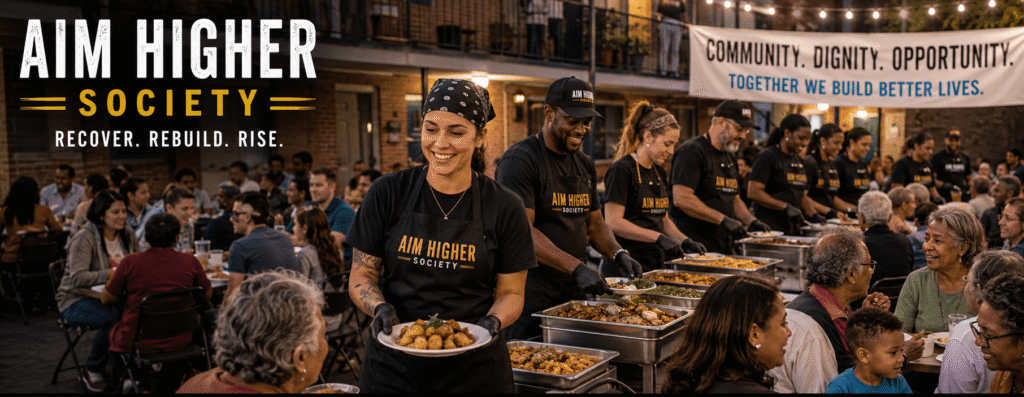
Food programs become more than meal distribution. They transform into:
Community-supported agriculture partnerships where residents participate in growing, harvesting, and preparing food—reconnecting with the elemental satisfaction of feeding oneself and others
Teaching kitchens where culinary skills become both therapy and vocational training
Shared meal traditions that create ritual, regularity, and relationship—combating the profound isolation that often accompanies homelessness
Cooperative models where the formerly food-insecure eventually become food providers for others
Employment as Purpose
Work in this framework transcends mere income generation. It becomes:
Skills incubators offering apprenticeships in trades, technology, arts, and social enterprises
Social purpose businesses embedded within the community—repair shops, cafes, urban farms, recycling operations—that generate both income and pride
Graduated responsibility that meets people where they are, whether that’s a few hours weekly or full-time commitment
Mentorship reciprocity where those who’ve stabilized help newcomers, creating intergenerational wisdom transfer
The Multi-Generational Imperative
Perhaps most revolutionary is the deliberate inclusion of multiple generations. Modern society increasingly segregates by age—seniors isolated in retirement communities, young people in their own enclaves. This compact reunites what has been fractured:
Elders bring wisdom, stability, and historical memory—their presence destigmatizes the community and provides intergenerational mentorship
Young families create vibrancy and future-orientation; children’s presence alone transforms a space from “facility” to “neighborhood”
Young adults provide energy and digital literacy while benefiting from affordable housing and community connection
Those in recovery or crisis find models of stability and possibility in others’ lived experience
This mixing creates natural support networks and combats the artificial categorization that treats “homeless people” as fundamentally different from everyone else.
The Public-Private Partnership Reconceived
Traditional public-private partnerships often mean government funding for private developer profits. This compact demands something more innovative:
Public Sector Contributions:
Land banking and long-term leases at nominal cost
Regulatory flexibility allowing mixed-use, innovative building designs
Integrated services hub—mental health, addiction treatment, job training, childcare—co-located with housing
Guaranteed income pilots providing baseline stability
Private Sector Innovations:
Social enterprises that prioritize mission alongside margin
Corporate “adopt-a-community” partnerships offering employment pathways and skills training
Foundation endowments creating permanent funding streams rather than project-by-project grants
Impact investment that measures success in lives stabilized, not just returns generated
Community Governance:
Resident-led councils with real decision-making power
Transparent budgeting where the community sees and shapes resource allocation
Cultural programming committees ensuring the space reflects the community’s diversity and values
Measuring Success Differently
The metrics of this compact are not:
Number of beds filled
Cost per client served
Recidivism rates
But rather:
Relationships formed and sustained
Skills acquired and applied
Community initiatives launched by residents
Length of stable housing maintained
Civic participation rates
Self-reported sense of belonging and purpose
Intergenerational connections created
Addressing the Inevitable Objections
“This is too expensive”
The current system—emergency services, incarceration, emergency medical care, shelter cycling—already costs billions. This compact frontloads investment to eliminate downstream costs. Studies repeatedly show housing-first models save money; this takes that logic further.
“Not everyone can be helped”
True. But the current system helps almost no one sustainably. This model, by creating conditions for flourishing rather than merely surviving, helps many more—and does so in ways that preserve dignity for those who struggle most profoundly.
“This enables bad behavior”
The evidence shows the opposite: when basic needs are met unconditionally, most people stabilize. The minority who struggle with addiction or mental illness need more support, not less—and are more likely to accept it in an environment of trust and belonging.
“Why should ‘they’ get what others work for?”
This compact eliminates “they.” By creating mixed-income, multi-generational communities, it weaves the formerly homeless back into the social fabric. Everyone contributes according to ability; everyone receives according to need. It’s the principle of community itself.
The Ripple Effects
When even one community successfully implements this compact, the effects radiate:
Neighboring property values stabilize as chaotic street homelessness decreases
Local businesses benefit from new customers and employees
Healthcare systems see reduced emergency costs
Criminal justice involvement decreases
Children born into these communities have fundamentally different trajectories than those born into generational homelessness
Other cities take notice and adapt the model

The Deeper Transformation
Ultimately, this compact is about more than homelessness. It’s about answering the question: What kind of society do we want to be?
One that segregates suffering out of sight, or one that integrates it into healing community?
One that treats human worth as contingent, or one that recognizes it as inherent?
One that solves problems through isolation, or through connection?
The homelessness crisis is fundamentally a relationship crisis—between individuals and society, between economic systems and human needs, between our stated values and our lived practices. The new social compact doesn’t just house the homeless; it rebuilds the bonds of reciprocity, solidarity, and mutual obligation that make a collection of individuals into a genuine community.
In creating these compassionate, integrated communities, we don’t just reduce a social problem. We create laboratories of what’s possible—models of human flourishing that remind us that we are, in fact, our siblings’ keepers, and that in caring for the most vulnerable, we strengthen the whole.
This is the true revolution: not just ending homelessness, but rediscovering what it means to belong to each other.